Thursday, March 01, 2018

School Construction Costs Are Rising, Grant Funding Would Start to Right the Ship


MACo Research Director Robin Eilenberg testified in support of Senate Bill 611, “Education – Healthy School Facility Fund – Established”, before the Senate Education and Health and Environmental Affairs Committee on February 27, 2018.

This bill establishes the Healthy School Fund which provides grant money to public schools to improve school facilities. With school construction costs increasing by over 50% in the past five years, it has been difficult for the State and count governments to keep up with school construction needs. The average school facility in the State is now 29 years old, and many require significant attention to address severe infrastructure and utility issues. This legislation begins the long road of addressing critical school building needs.

Read more HERE

Saturday, February 24, 2018

Student Screenings Are an Unfunded Mandate


MACo Legislative Director Natasha Mehu testified before the Senate Education and Health and Environmental Affairs Committee in opposition to Senate Bill 548 on February 21, 2018.

This bill would require local boards of education to conduct specific screenings to identify children with reading difficulties. Without any mechanism for state funding, this potentially costly mandate will be entirely placed on county boards of education. Several new standards and screenings would be established requiring training of employees that could take a substantial amount of time and resources.
Read more HERE

Friday, February 23, 2018

Minding the Gap: Career and Tech Grant Funding Program


MACo submitted written testimony in support of House Bill 1098 and Senate Bill 515, “Career and Technology Education and Workforce Investment Act”, to the House Appropriations and Senate Budget and Taxation Committees.

These bills would established a grant program for career and technology education facilities, while also repealing certain spending mandates on scholarships by making them optional. Local jurisdictions would have to match the State input of the grant allotted by the governor up to $2 million. This affords counties more flexibility and allows them to address growth and facility concerns in different ways.
Read more HERE

Thursday, February 22, 2018

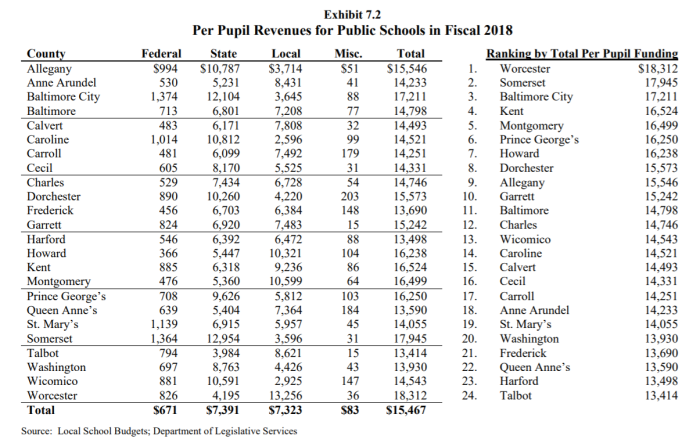
2018 School Funding Per Student County-by-County


Among the information contained in the Overview of Maryland Local Governments: Finance and Demographic Information is a chart of per-student funding in each Maryland county. The funding shows a range of funding for public education throughout Maryland on a per pupil basis.

Screenshot 2018-02-20 19.23.41
Read more HERE

Saturday, February 17, 2018

Innocence Stolen: Protecting Our Children Online

The Innocence Stolen Presentation was given at the

The Innocence Stolen: Protecting Our Children Online program, was presented at the Parent Advisory Council Meeting on January 23, 2018.  This presentation provided information on how adults can keep children safe from negative and unlawful activity online. The presentation and discussion addressed prevention, internet safety, and intervention strategies.

Presentation handouts can be found HERE.

Friday, February 16, 2018

Hogan Announces Plan for Casino Revenue “Lockbox” to Boost Education Funding


Conduit Street Maryland

Governor Larry Hogan, flanked by Comptroller Peter Franchot and Secretary of Budget & Management David Brinkley, today announced the “Commitment to Education Act of 2018,” a proposal to ensure that taxes on casino revenues set aside for education are used to supplement, not supplant state funding for public schools. According to Governor Hogan, his plan will add $1 billion in school construction funding and $3.4 billion in operating funding for public schools over the next ten years.
Last month, legislature leadership announced a plan to place a constitutional amendment on the November ballot. The ballot question would ask voters to approve of putting a “lockbox” on casino money (around $500M per year), requiring it to be used for education above the amount set by state formulas. The Governor’s proposal would not require a referendum, it would be done through statute.
According to Governor Hogan, his legislation would phase-in casino revenues to a special fund (the “lockbox”) over the next four years. The first 20% percent would be used for school construction projects (around $100 million next year) and the rest would be used to supplement operating budgets.
The Administration is expected to provide more details on the proposal in the coming days.

Tuesday, February 13, 2018

Notes from Board of Education Meeting, 2/13/18

The Board of Education meeting on Tuesday, February 13 will be re-broadcast on Comcast Channel 96, Verizon FIOS Channel 12 and is available via webstream at http://www.ccboe.com/ . To view the full agenda and the various reports, please visit BoardDocs .


The below notes are my personal notes and are not intended to be all-inclusive or official minutes for the Board of Education meetings and are provided as a request from my supporters and the general public in a personal effort to be more transparent. Although I have diligently tried to make these notes as unbiased and accurate as possible, I am only human and do make mistakes.

I had the privilege of being shadowed by Morgan Hawkins a 5th grader from William B. Wade Elementary.


Executive session – 12 p.m.
Call to order – 1 p.m. - Pledge of Allegiance, North Point High School
Recognition of 2018 Legislative Pages - List
Superintendent’s update - Report
Correspondence/Board Member updates
  • McGraw - Congrats to staff on graduation rate; tour Mudd/Billingsley renovation; Minority Achievement meeting; Transportation Conversation; MABE Policy Committee; NSBA Equity Symposium; Deadline for Scholarships coming up soon
  • Kelly - Parents check student devices; PAC - Innocence Stolen Presentation; Be the Difference nominations due 4/1; Congrats to Spartones and Unplugged
  • Marshall - St. Valentine's Day and Women's Heart Health Awareness month; Equity Symposium
  • Lukas - Equity Symposium; SECAC meeting; Seven Up Art Reception; Vex Robotics; Transportation Conversation; PAC meeting; #21 St. Charles Basketball
  • Abell - SECAC Meeting; Seven Up Art Exhibit at Mattawoman; Tour Mudd/Billingsley; Transportation Conversation - didnt think there was much conversation/collaboration, looking forward to future dialogue; Tour Mattawoman, Ms. Jones, Gateway class and restorative circle; inaugural Senior Seminar lunch; 6th grade boot camp and MBA league; Tour Berry - Ms Zeier and Ms. Taylor, character education; rocket building; all schools request more and updated technology and resources.
  • Palko - CSM Graduation; Polar Plunge; Minority Achievement Meeting; Art Exhibit; Vex Robotics; Stethem Honor Society; Equity Symposium; Transportation Conversation; Unified Bocce Tournament; Billingsley/Mudd Tour; Congrats on Graduation rates
Education Association of Charles County update - Report

American Federation of State, County and Municipal Employees update - Report

Student Board Member update - Report

Synergy/online scheduling - Presentation

  • Abell - concern with putting students in groups; will their program of studies still be individualized?  would like a clause on parent verification sheet stating changes can be made.
  • Kelly - coarse selections not getting until April for Somers to LaPlata. Will it affect courses availability? Staff will look into.
  • McGraw - Elementary - will thy still need articulation meetings?
  • Palko - Program of Studies will be interfaced with Synergy
  • Carter - schedules can be altered based on parent requests

Infants and Toddlers Program at the F.B. Gwynn Educational Center - Presentation

  • Thank you from various board members regarding personal experience with the program
  • Working on possible partnership with CSM

Facilities study progress - Presentation; Mudd

  • GWWO Study revisted; where we are now and whats next
  • Kelly - do we have enough funding to do what we need to do?  Staff says yes; if we had more funding we could do more but we wont be in a deficit.
  • McGraw - no more QZAB Funding

Project status update - Presentation

Work session review
  • Fine and performing arts funding
    • $225,000 in operating budget (mainly for purchasing and repairing instruments); $524,000 from student activity fee, fundraising, gate receipts (everyday supplies for performance)
  • Teachers’ Grant Challenge
    • legislation enacted in 2001 during recession.  high demand for teachers and low supply.  SB810/HB1247 stated each local agency to provide 4% increase the state would kick  in 1%.  Initially for two years and Glendening extended for 1 year.  Charles County received $3.6M  state was $72M and came from cigarette restitution fund.  2018 sees critical demand for competitive teacher salary.   Charles is ranked 9th in starting teacher salary but compare to cost of living index it brings us down to 14th ranking in the state.  After initial bill and funding disappeared counties had trouble compensating for the additional 1%.  If we bring up again to the state level, there must be a recurring funding source,  No talk of this at the state level to date.
Legislative update
  • HB1415 - Kirwin commission bill; new recruitment for teachers; attracting hs students to teach; state grants; mandate moe for PK programs; additional state support for schools with highest poverty; tech ed grants cost is $10-$20M state wide.
  • SB819/HB811 - collective bargaining bill - mandate collective bargaining for new teacher processing 
  • SB302 - governors initiatives - state inspector general for education
  • SB301 - governors initiative - rewrite ESSA plan increase accountability
Unfinished Business
  • Results of environmental scan
    • 2,600 people responded and 47% were parents, 31% staff
    • 90% education is important
    • #1 purpose of public school - Help students fulfill their potential and have choices in life
    • #1 most important skill to gain by graduation - Basic reading and math
    • #1 value in public school - safe and orderly school environment; #2 Quality of teaching
    • #1 most proud of CCPS - Achievement of students; #2 Quality of staff
    • #1 Improvement Priority - Improve students basic academic skills; #2 increase rigor and raise expectations
    • CCPS students graduate college and career ready - 40% agree 28% disagree
    • CCPS provides opportunities for parents to get involved - 64% agree 22% disagree
    • Well informed about school issues - 60% agree 29% disagree
    • CCPS lets me share my opinion meaningfully - 43% agree 38% disagree
  • “Playing with Fire” video - created by Charles County Government, schools, health dept, sheriff's office and jude house chronicling a family who lost a son to overdose.
    • working on plans to start showing this next school year.  Students are doing Truth and Consequences courses.  New DARE car design to support Opiod crisis.
New business - None

Future agenda items

  • Abell - generic school lunch accounts at each school to receive donations
  • Abell - Discipline Update review and board direction
  • Kelly - Grading Policy Review
  • Kelly - Feasibility of moratorium on Berry & Matula
  • Lukas - 

Recognition
  • Charles County Arts Alliance presentation
  • La Plata Rotary Club
  • Resolutions
    • Read Across Charles County: Accepting:  Lauren Washington, reading resource teacher, J.P. Ryon Elementary School; Karen Wagner, reading recovery teacher, T.C. Martin Elementary School; William Burke, third grade student, Ryon; Tanya Burke, fifth grade student, Ryon
    • Women's History Month: Accepting: Maxine Somerville, Chair, Commission for Women
    • Fine and Performing Arts Month: Accepting: Siobhan O’Brien, chorus teacher, Matthew Henson Middle School
    • Black History Month: Accepting: Corrine Reed, fifth grade student, Walter J. Mitchell Elementary School; Tysean Sanders, fifth grade student, Mitchell; Jonas Agyeman, fifth grade student, J.P. Ryon Elementary School; Nina Bulls, fifth grade student, Ryon
    • Career and Technical Education Month: Accepting:  North Point High School's Keith Gascon, electrical construction instructor; Nathan Kavlick, electrical construction, twelfth grade student; Maya Poindexter, culinary arts, twelfth grade student
    • Robert D. Stethem Educational Center: Accepting:  John Young, HVAC instructor; Cody Akers, twelfth grade student, HVAC, La Plata High School; Kevin Frank, twelfth grade student, HVAC, La Plata High School; Cameron Harris, eleventh grade student, HVAC, Henry E. Lackey High School
    • Gifted and Talented Education Month: Accepting: Mary H. Matula Elementary School, Christina Caron, learning resource teacher; Jessica Meador, fifth grade teacher; Garrett Carson, fifth grade student 
  • Students
    • Dakota Knott; twelfth grade; Academic Achievement; Henry E. Lackey High School; Principal: Kathy Perriello
    • Nehemiah Strawberry, eighth grade; Academic Achievement; John Hanson Middle School; Principal: Susan McCormick
    • D’Kairi Boone; eighth grade; Academic Achievement; Benjamin Stoddert Middle School; Interim Principal: Marvin Jones 
    • Adrienne Rae Briones; fourth grade; Personal Responsibility; C. Paul BarnhartElementary School; Principal: Ben Kohlhorst
    • Noah Hyson, fifth grade; Career Readiness; Dr. Gustavus Brown Elementary School; Principal: Christienne Warren
    • Kayleigh Stewart, fifth grade; Personal Responsibility; T.C. Martin Elementary School, Principal: Robert Opiekun
  • Staff
    • Alan Freeman, music teacher, Lackey
    • Nichole Thomas, school counselor, Hanson
    • Julie Colaizzi, learning resource teacher, Stoddert
    • Pamela Pichola, teacher, Barnhart
    • Tina Thomas, secretary, Brown
    • Constance Sorzano, media instructional assistant, Martin

Public Forum – 6 p.m.


  • Susan Eckerle - LPHS Band and Orchestra Director, course selections - course requirements doesn't allow for the electives and music program is stagnating.  Request block scheduling.
  • Maureen Meers - parent, supports Decoding Dyslexia MD; HB910/SB548 offers prescreening for elementary age schools.  Asks for support of bills.  Requests properly trained educators. HB493/SB698 requires teaching candidates proficient in reading teaching??  1 in 5 students have dyslexia.


Action Items
  • Minutes
Motion to approve the Minutes by Abell; Second by Marshall
Yes:  Abell Crawford, Kelly, Lukas, Marshall, McGraw, Palko
  • Personnel
Motion to approve Personnel by Abell; Second by McGraw
Yes:  Abell Crawford, Kelly, Lukas, Marshall, McGraw, Palko
  • FY2019 proposed operating budget
Motion to approve the FY2019 Operating Budget by Abell; Second by McGraw
Yes:  Abell Crawford, Kelly, Lukas, Marshall, McGraw, Palko

    • Kelly requests adding block scheduling to all high schools.  Motion to amend.  No second.  Amendment fails.
    • Abell requests study on block scheduling.
Adjournment 

13th Annual SECAC Staff Appreciation Award Nominations

The Charles County Special Education Citizens Advisory Committee (SECAC) invites parents and guardians to nominate the person or team who has made a difference in the life of your child with special needs.
  • Nominations must be made by the parent, guardian or the student (not other staff members).
  • A lot of people help our children, but please limit your nomination to one (1) of the four (4) categories listed below.
  • Please make sure the staff member has had direct contact and impact on your child (i.e. not just a nice person that helped you or your family…but someone that actually did something directly for your child).
  • Nominations should be for a staff member who has “gone beyond the call of duty” to make a child successful during the 2017-2018 school year.
The easiest way to nominate is with the digital link below.

Thursday, February 08, 2018

NSBA Equity Symposium

The National School Boards Association recently held a very informative Equity Symposium in Washington, DC .


Here is a link to one of the presentations by Nancy S. Fishman, Deputy Director of ReadyNation (www.readynation.org) and Tom Gentzel, Executive Director & CEO of NSBA:  


Additional presentations can be found HERE.

Friday, February 02, 2018

Apply Now for the NACo/Nationwide Scholarship!

The National Association of Counties and Nationwide are accepting applications for a scholarship, honoring their 39 years of partnership.
naco-nationwide.png
Are you Eligible?
  1. Be a high-school senior
  2. Have a parent, grandparent, or legal guardian enrolled in and actively contributing to a 457 (b) plan offered through the NACo Deferred Compensation Program
  3. Be a U.S. citizen
  4. enroll in a full-time undergraduate course of study no later than the autumn term of the 2018-2019 school year at an accredited two- or four-year college
  5. NOT be an immediate family member of a of NACo employees, members of the NACo Defined Contribution and Retirement Advisory Committee or its governing board of directors, staff of individual state Association of Counties that are members of the LLC
  6. NOT be an employee of Nationwide employees
About the Program
The 13-year-old program allows high-school students to explore the transition into the next stage of life.
Young adults should understand the importance of preparing for a comfortable financial future as well as be aware of potential obstacles. The NACo/Nationwide essay contest allows the next generation of retirees to give insight into what retirement services looks like to them, a group of consumers whose purchase decision is years away. By the same token, educating our next generation on the importance of retirement savings will not only benefit the individual but their entire microsystems. The continued NACo/Nationwide partnership not only raises awareness in this vital area, it also continues the discussion and works to take the current retirement system to a whole new level. I expect great things from our 2018 winners. May their contributions be a ripple effect towards new and improved lifestyles.
– According to NACo’s President Roy Brooks
How to Apply
  1. Fill out the online application
  2. Submit an essay, 500 words or fewer
  3. Follow the essay prompt:
Young people often hear from parents and grandparents about the importance of saving and planning for their future. That can be tough advice to follow since most young people aren’t fluent in the language of money, yet are expected to make big financial decisions as early as in their teens. Retirement is decades away and many entry-level jobs, even for college graduates, don’t pay enough to make saving easy. Establishing a savings and investment plan early is one of the most important actions young people can take to protect their financial future. Provide two to three reasons why establishing a savings and investment plan early is important to you and how you plan on achieving your financial and savings goals.
4. Submit before March 5, 2018

Thursday, February 01, 2018

List of 2019 School Construction Projects Approved for State Funding


The current year’s Capital Improvement Program as approved by the Board of Public Works on January 24th, 2018 is now available online.
As described, this is part of the way through the approval process for 2019 projects. In January, the Board of Public Works approved the recommendations of the IAC for 75% of the Governor’s preliminary allocation for fiscal year 2019.
As described in the Introduction to the Capital Improvement Program report,
The IAC will meet in February 2018 to consider additional staff recommendations to reach 90% of the Governor’s submitted capital budget. In accordance with statute, the IAC will submit the 90% recommendations prior to March 1 to the Board of Public Works, presiding officers and budget committees of the General Assembly, the Department of Legislative Services, local education agencies and county governments. No formal approval is required for the recommendations.
The Public School Construction website lists projects by county and provides a summary document of all requests.

Another Way To Skin the School Construction Cat

Been saying this for years...


MACo Research Director, Robin Eilenberg, testified in support with amendments of Senate Bill 92, “Maryland School Overcrowding Reduction Act of 2018”, in front of the Senate Budget and Taxation Committee on January 31, 2018. This bill aims to change current school construction laws that would increase flexibility for county and local governments in their ability to seek alternative financing for school construction.
While counties support this increased flexibility, in addition to the potential of lowering school construction costs, there are concerns about underlying laws surrounding the treatment of capital leases under school funding rules that are not addressed in the bill.
While this legislation makes some changes to existing law, however, it does not address a central hurdle to experimentation – a lack of clarity in the treatment of capital leases under school funding rules.
Incentives for counties and school boards to reduce school construction costs could help spur best value development and renovation. The incentive program envisioned in this legislation, however, misses an opportunity to encourage cost-effective practices across all types of construction, whether traditional or alternative.”

Follow MACo’s advocacy efforts during the 2018 legislative session here.

Friday, January 26, 2018

What Do We Know About School Discipline Reform?

Assessing the alternatives to suspensions and expulsions


By  and  

Education Next

ednext_XVII_1_steinberg_img01
The U.S. Department of Education’s Office for Civil Rights announced this spring that the number of suspensions and expulsions in the nation’s public schools had dropped 20 percent between 2012 and 2014.
The news was welcomed by those who oppose the frequent use of suspensions and expulsions, known as exclusionary discipline. In recent years, many policymakers and educators have called for the adoption of alternative disciplinary strategies that allow students to stay in school and not miss valuable learning time. Advocates for discipline reform contend that suspensions are meted out in a biased way, because minority students and those with disabilities receive a disproportionate share of them. Some also assert that reducing suspensions would improve school climate for all students.
Government leaders have taken steps to encourage school discipline reform. The Obama administration has embarked on several initiatives to encourage schools to move away from suspensions and toward alternative strategies. In 2011, the Department of Education (DOE) and the Department of Justice (DOJ) launched the Supportive School Discipline Initiative to coordinate federal efforts in this area. In January 2014, the DOE released a resource package with a variety of informational materials designed to support state and local efforts to improve school climate and discipline. The package included a “Dear Colleague” letter, issued jointly by DOE and DOJ, warning against intentional racial discrimination but also stating that schools unlawfully discriminate even “if a policy is neutral on its face—meaning that the policy itself does not mention race—and is administered in an evenhanded manner but has a disparate impact, i.e., a disproportionate and unjustified effect on students of a particular race.”
Discipline reform efforts are also underway at the state and school-district levels. As of May 2015, 22 states and the District of Columbia had revised their laws in order to require or encourage schools to: limit the use of exclusionary discipline practices; implement supportive (that is, nonpunitive) discipline strategies that rely on behavioral interventions; and provide support services such as counseling, dropout prevention, and guidance services for at-risk students. And as of the 2015–16 school year, 23 of the 100 largest school districts nationwide had implemented policy reforms requiring nonpunitive discipline strategies and/or limits to the use of suspensions. In an April 2014 survey of 500 district superintendents conducted by the School Superintendents Association (AASA), 84 percent of respondents reported that their districts had updated their code of conduct within the previous three years.
What evidence supports the call for discipline reform? How might alternative strategies affect students and schools? In this article, we describe the critiques of exclusionary discipline and then examine the research base on which discipline policy reform rests. We also describe the alternative approaches that are gaining traction in America’s schools and present the evidence on their efficacy. Throughout, we consider what we know (and don’t yet know) about the effect of reducing suspensions on a variety of important outcomes, such as school safety, school climate, and student achievement.
In general, we find that the evidence for critiques of exclusionary discipline and in support of alternative strategies is relatively thin. In part, this is because many discipline reforms at the state and local levels have only been implemented in the last few years. While disparities in school discipline by race and disability status have been well documented, the evidence is inconclusive as to whether or not these disparate practices involve racial bias and discrimination. Further, the evidence on alternative strategies is mainly correlational, suggesting that more research is necessary to uncover how alternative approaches to suspensions affect school safety and student outcomes.
Addressing such questions is vitally important, because a safe school climate is essential for student success. A recent National Center for Education Statistics report documented downward trends in suspensions, student victimization, and reports of bullying. Since 2006, out-of-school suspensions have declined, with more recent declines in expulsions (see Figure 1). Still, more than one-third of teachers in 2012 reported that student behavior problems and tardiness interfered with their teaching. Regardless of the kind of discipline districts choose to employ, policymakers and school leaders must recognize that school disorder and violence have adverse effects on all students. For example, students who were exposed to Hurricane Katrina evacuees with significant behavior problems experienced short-term increases in school absences and discipline problems themselves. Recent evidence also shows that exposure to disruptive peers during elementary school worsens student achievement and later life outcomes, including high school achievement, college enrollment, and earnings (see “Domino Effect,” research, Summer 2009). These findings highlight the importance of closely monitoring the effects of discipline reform on all students.
ednext_XVII_1_steinberg_fig01_updated

Read more HERE 

Thursday, January 25, 2018

Educating Independent Children in a Technologically Dependent World:

An excerpt from Be the Parent, Please: Stop Banning Seesaws and Start Banning SnapChat
By  01/08/2018

Education Next


Technology has changed the way kids are raised and educated. In her new book Be the Parent, Please: Stop Banning Seesaws and Start Banning SnapChat, Naomi Schaefer Riley offers parents strategies for helping children grow up with sensible boundaries as well as a sense of independence. In the following excerpt, she visits a nature club for homeschooled students, where children are developing social and emotional skills the old-fashioned way.

A couple of months after my son started second grade, I remember him poring over an atlas on our family room floor. He asked me about finding Massachusetts on a map—that’s where his grandparents live. When I told him to look further north, he seemed puzzled. “Simon, which direction is north?” I asked. Without hesitation, he answered, “Up.” It was a perfectly logical answer for someone who liked maps but was used to seeing them pinned to the front of a classroom rather than actually using them to get places.
A few weeks after this conversation, I found myself at a state park in the suburbs of Philadelphia with a group of about thirty kids ranging from toddlers to teenagers. A young man in his twenties took out a map of the park and handed a few other copies to the kids. Then he took out his compass—a couple of the kids pulled out their own as well—and asked them which way we should go to get to the trail. The kids laid their maps on the ground and quickly found the answer. “That way is north,” yelled one boy who looked to be about ten. “We need to head to the left up ahead.”
Like many of the kids at the park that day, this boy seemed confident, knowledgeable about his surroundings, and happy to talk to other kids of different ages, not to mention their parents. He was curious and excited but also surefooted and eager to warn others about pitfalls on the trail ahead.

Read more HERE

Discipline Resources

This blog post is dedicated to providing resources and links for a social media brainstorming session to help provide solutions to the ongoing discipline conversation in Charles County Public Schools.

Wednesday, January 24, 2018

Governor Budgets More Dollars for School Construction


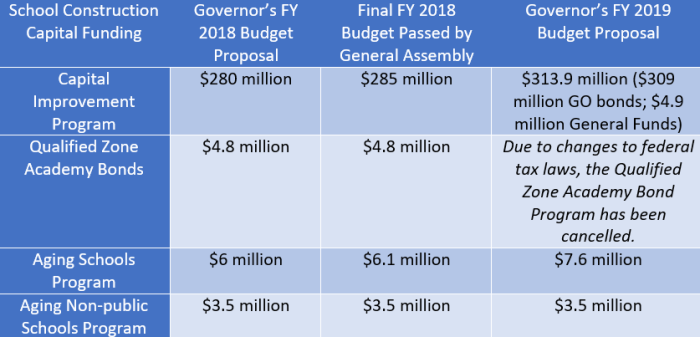
The Governor’s FY 2019 budget contains millions more in capital improvement program funding — the central source of state funding for Maryland school construction.
The following chart shows the Governor’s FY 2018 budget proposal for school construction, the General Assembly’s final capital budget for FY 2018, and the Governor’s FY 2019 budget proposal.
Screenshot 2018-01-19 14.50.41

Additional capital funding is provided to schools with high enrollment or high numbers of relocatable classrooms, and to Baltimore City schools, under separate statutory provisions.